

How to Fit Door Hinges: A Practical Guide to a Well-Hung Door
By Colt Carpentry Devon
A door should open smoothly, close neatly and sit comfortably within its frame. When it catches on the floor, drops at the handle side or squeaks every time you use it, the hinges and their fixings are a good place to start checking.
Fitting door hinges takes careful preparation. Choosing suitable hardware, cutting tidy recesses and fixing into sound timber all contribute to a better result. This guide explains the main stages of fitting conventional butt hinges to a timber internal door, alongside common problems to look out for.
For homeowners looking for door fitting in Devon and Cornwall, Colt Carpentry Devon offers internal and external door fitting, door adjustments and carpentry work with attention to the finishing details.
Choose the right hinges before you start
The right hinge depends on the door’s weight, construction, dimensions and intended use. Check the door and hinge manufacturers’ instructions before choosing the size, quantity and positions. A hinge leaf’s thickness determines the depth of its recess; it does not need to match the thickness of the door.
Common options include:
- Standard butt hinges: a familiar option for timber doors, with leaves recessed into the door edge and frame.
- Ball-bearing butt hinges: designed to reduce friction, with suitable models available for heavier or frequently used doors.
- Rising butt hinges: lift the door as it opens. They require the correct handing and clearance, and should not be assumed to provide reliable self-closing in every installation.
- Projection or parliament hinges: useful where a door needs additional clearance around surrounding trim; check the particular hinge and opening arrangement.
Flush and cabinet hinges have different fitting requirements. Do not assume small cabinet hardware can carry a full-size room door.
External doors also need hardware suited to their exposure and security requirements. This can be especially relevant for properties near the Devon and Cornwall coast.
How many hinges does a door need?
There is no single rule covering every door. Some lightweight internal doors use two hinges; other doors require three or a different specified arrangement. Follow the instructions and load rating rather than choosing solely by appearance or a generic weight threshold.
Fire doors require a separate approach. Use the door’s certification and installation instructions to determine compatible hinges, fixings, positions and any specified hinge protection. A hinge described as “fire rated” does not automatically make it suitable for every fire door. Installation and repairs should be undertaken by someone competent in that particular system.
Tools and materials for fitting door hinges
Have everything ready before lifting or cutting the door:
- Suitable hinges and specified screws
- Tape measure, pencil and combination square
- Marking knife and marking gauge
- Sharp wood chisels and a mallet
- Drill, appropriate pilot bits and screwdriver bits
- Hand screwdriver for controlled final tightening
- Spirit level or straightedge
- Door wedges or a door lifter
- A stable work support or door clamp
- Eye protection, plus hearing and dust protection where power tools require it
A router and compatible hinge jig can help with repeated recesses, but they are optional. Use the cutter and guide arrangement specified for the jig. Keep hands behind cutting edges and support the door securely throughout the work.
Step 1: Check the door and frame
Before marking hinges, inspect the frame for movement, splits, decay or damaged screw holes. New hinges will not solve a loose lining or rotten timber.
Check how the door fits in the opening and confirm its opening direction. Follow its trimming limits, especially with hollow-core and engineered doors. Account for the finished flooring and the clearances specified for the door.
If replacing an existing door, its hinge recesses may provide a useful reference, but inspect their condition and compatibility first.
Step 2: Mark the hinge positions
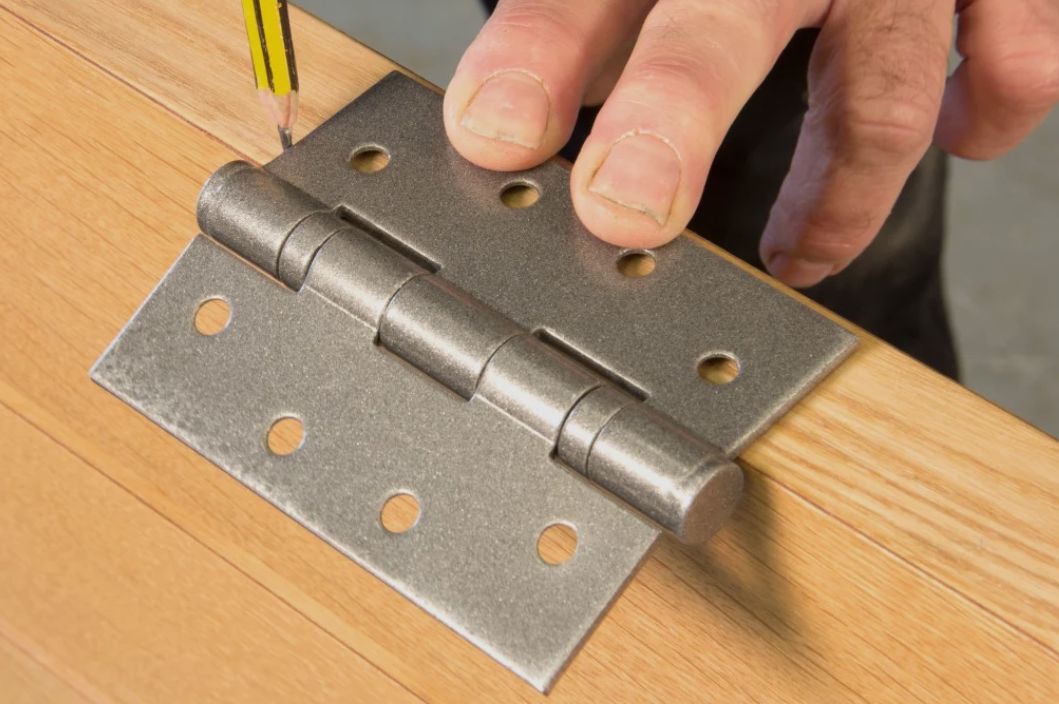
Use the manufacturer’s hinge layout where supplied. Do not treat a fixed distance from the top or bottom as a universal rule, and do not automatically put a third hinge halfway between the other two.
For a replacement in a sound existing frame, position the door in the opening on wedges with the required gaps, then transfer the frame’s hinge positions to the door.
Clearly mark each hinge’s top and bottom edges. Set the hinge leaf against the door edge with the knuckle positioned to allow the intended swing. Use the square and gauge to keep the layout consistent, then score the outline lightly with a marking knife.
Before cutting, check the hinge side and opening direction again.
Step 3: Cut a clean hinge recess
The recess, also called a mortise, should allow the hinge leaf to sit level with the surrounding timber.
Mark the depth from the actual hinge leaf. With the door secured, make shallow cuts within the outline and remove the waste gradually. Avoid levering against the finished edges or taking out a thick piece in one go.
Test the hinge regularly as you work. It should sit flat without rocking, with a tidy outline around it. Leave the recess too shallow and the leaf stands proud; cut too deeply and the door’s alignment can be affected.
Repeat for each hinge, maintaining the same setback and depth where the hardware requires it.
Step 4: Drill pilot holes and attach the hinges
With the hinge seated, mark the screw centres accurately. A self-centring hinge bit can help prevent a screw pulling the leaf sideways.
Choose the pilot-hole size and depth for the screw and timber involved; one drill-bit size will not suit every installation. Use the specified screws, checking that their heads sit correctly in the countersinks.
Secure the hinges to the door, tightening carefully. Overdriving can strip the timber or distort the hinge. An impact driver needs particular care here.
Step 5: Transfer and cut the frame recesses
If the frame has no existing recesses, support the door in its intended position and transfer the hinge locations accurately. Remove the door before cutting the frame.
Prepare the matching recesses gradually and test the leaves for a flush fit. Check that the hinge knuckles align along the same axis: an incorrectly positioned hinge can make the door bind.
Step 6: Hang the door and test its movement
Support the door’s weight on wedges or a lifter while attaching the frame leaves. Use a helper for a heavy or awkward door.
With sufficient fixings holding it securely, open and close the door slowly. Check the gaps, floor clearance and contact with the stops. Make any necessary adjustments before completing all required fixings, then test again.
Do not leave a door in use with missing screws or loose hinges.
Troubleshooting door-hinge problems
The door drops at the handle side
Check the top hinge, its screws and the condition of the timber. Tightening can help only if the screw still has a sound grip. Worn hinges, loose frames and damaged fixings may require repair or replacement.
The screw holes no longer hold
Ordinary decorative filler is not a dependable load-bearing repair. On a conventional non-fire-rated timber door or frame, a properly fitted glued timber plug, followed by a correctly positioned pilot hole once cured, may provide a suitable repair. Split or rotten timber needs more substantial attention. Follow the relevant system instructions for fire doors.
The door binds at the hinge side
Inspect recess depth, hinge alignment and screw heads before planing the door. Removing timber without identifying the cause can create an unnecessary gap elsewhere.
A hinge squeaks
Check for wear and loose fixings, then use a lubricant suitable for that hinge if its manufacturer permits it. Protect nearby finishes and wipe away excess. Lubrication cannot repair a bent or failing hinge.
The gaps are uneven
Check the frame and hinge seating first. A suitable rigid packer can sometimes correct an over-deep recess on an ordinary timber door, but adjustment depends on the location and cause of the problem. Avoid guessing or using compressible packing as a lasting repair.
Frequently asked questions
Can I replace hinges without taking the door off?
Sometimes, if the replacement hardware matches and the door is securely supported. Changing one hinge at a time can be practical on a suitable door. If the recesses need alteration or the door is heavy, removing it and working on stable supports is usually easier to control.
Should hinges be fitted to the door or frame first?
Both sequences can work. Existing frame recesses may be used to establish the door positions; on a new installation, hinges can be fitted to the door before transferring the positions to the frame. Accurate marking and secure support matter most.
Can I use longer screws to stop a door dropping?
A longer suitable screw may help where it reaches sound timber, but it is not a cure for damaged wood, incorrect alignment or a loose frame. Check the required fixing specification and what lies behind the drilling position first.
Do new doors need finishing around the hinge recesses?
Follow the door manufacturer’s finishing instructions. Newly cut areas may need sealing or coating, and the required treatment varies with the product.
Professional door fitting across Devon and Cornwall
A carefully fitted door makes an everyday difference. Whether you are replacing internal doors, fitting a timber external door or addressing a door that catches, Colt Carpentry Devon can help with the carpentry and finishing work.
Based near Bere Alston, enquiries are welcome from Tavistock, Plymouth, Exeter, Okehampton, Newton Abbot, Torquay and Dartmouth, as well as Bude, Bodmin and Padstow and surrounding areas of Devon and Cornwall. Contact Colt Carpentry Devon to discuss your location, door type and requirements.
Get in touch today for a free quote for door fitting, hinge replacement or door adjustments.
Made to measure. Built with care. Made to last.
Website SEO details
SEO title: How to Fit Door Hinges | Colt Carpentry Devon
Meta description: Learn how to fit door hinges, cut tidy recesses and fix common problems. Contact Colt Carpentry Devon for door fitting across Devon and Cornwall.
Suggested URL slug: how-to-fit-door-hinges
Primary search phrase: how to fit door hinges
Supporting phrases: internal door fitting Devon, door hanging Plymouth, door hinge replacement, carpenter Tavistock, external door fitting Cornwall, door adjustments Okehampton, carpentry and joinery Devon.
Suggested internal links: Link relevant wording to your internal and external door fitting service page, bespoke joinery page and contact page, using the actual URLs on your website.
Suggested photo captions and alt text: Use your own photographs and describe what each shows, for example “Hinge recess being cut into a timber internal door” or “Finished internal door installation by Colt Carpentry Devon”. Include a town only when it is the actual job location.